Crimea
Grey BeesCrimea is the peninsula where Sergey Sergeyich’s search for a safe place to keep his bees turns into an encounter with displacement, political suspicion, and the limits of refuge. He arrives hoping to give his apiary a proper holiday, but the place he has long imagined as a destination becomes a temporary home marked by Russia’s control, Akhtem Mustafayev’s disappearance, and the pressure to watch his words. Its significance rests in that reversal: a hoped-for escape becomes an ordeal, while the bees’ needs keep Sergeyich’s attention fixed on practical survival.
A destination transformed by political change
In the foreword, Crimea is situated within the upheaval that followed Euromaidan. Russia captured the peninsula in 2014 as power in Ukraine passed to pro-European forces, and the narrator describes his family’s last visit in January of that year, before the annexation. He calls the novel’s Crimean half, in part, a farewell to a Crimea that may no longer exist. The place Sergeyich approaches, then, is not simply the holiday landscape he once longed to see: the peninsula has undergone a political transformation that shapes the welcome he receives and the risks surrounding his stay.
Before his journey, Sergeyich speaks of Crimea as somewhere he has always wanted to visit: to swim in the sea, lie on a beach, and return tanned. His connection to it is also personal. At a beekeeping convention he met Akhtem Mustafayev, a Crimean Tatar beekeeper who repeatedly invited him south, though Sergeyich had never managed to go. When war pushes him to leave home with his apiary, that old invitation gives the journey a destination as well as a practical purpose.
A place for the apiary
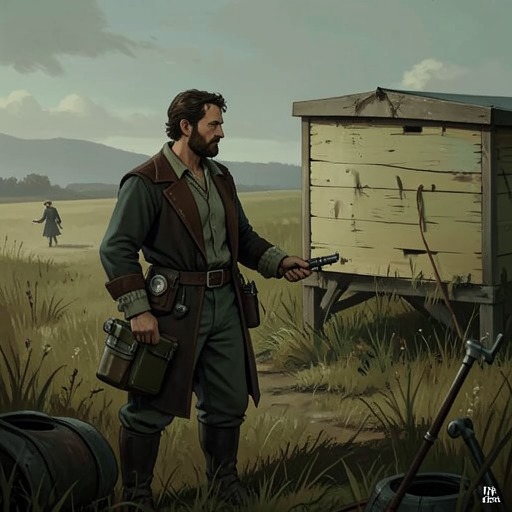
Sergeyich’s stay takes him to Kuybyshevo, near Bakhchysarai, where he settles by the apiary of Akhtem and Akhtem’s wife, Aisylu. The hives stand among almond and fig trees on a slope reached by a road that becomes a path; Sergeyich counts at least two dozen of Akhtem’s brightly coloured hives. He immediately considers where his own can go, choosing a place a little nearer the turn in the road, and asks Aisylu to help unload them. Crimea becomes, in this scene, a working landscape rather than a holiday backdrop: its value to Sergeyich is measured in whether the bees can be placed, tended, and kept alive.
The journey south is also an attempt to preserve a livelihood and the routines that give Sergeyich purpose. Before leaving, he plans to close the hive entrances, load the hives onto a flatbed trailer, cover them against the rain, and secure them for travel. He packs honey as well, thinking of it as money that keeps its value. The mild, rainy weather is suitable for transporting the bees because cooler conditions reduce the danger of overheating inside the hives. In Crimea, this attention continues: Sergeyich watches the bees emerge and explore their new surroundings after the difficult trip, and their settling becomes a measure of his own ability to make a temporary life there.
Friendship, loss, and constrained hospitality
The invitation that brings Sergeyich to Crimea acquires a painful meaning when he learns that Akhtem is missing. At a Russian security-service office, an official describes Sergeyich as a foreigner admitted for humanitarian reasons, warns him not to show ingratitude, and tells him that he may stay for no more than ninety days. The official directs Akhtem’s widow to report the case to the police and suggests that either Crimean Self-Defence or the Cossacks may be involved. Sergeyich has come to see a friend, but the conversation recasts him as a guest whose presence is conditional and whose words may be scrutinized.
Aisylu’s account links the present to the Crimean Tatar deportation: her mother named her after a younger sister who died during the deportation, when the girl was still very small. The family history gives the landscape around the apiary a past that cannot be separated from current vulnerability. Sergeyich’s sympathy for Crimean Tatars, identified in the foreword as a source of suspicion from the security service, further unsettles any idea that he can remain an uninvolved visitor. He is trying to care for bees, yet the people and authorities around them draw him into questions of disappearance, belonging, and political allegiance.
Exchange and temporary stability
Even in displacement, Sergeyich builds a modest economy around the honey. On his first day at Nadya’s shop, he exchanges honey for bread, sausage, and artesian water. Because the amount of food he chooses does not match the honey’s value, Galya gives him store credit of 560 hryvnias, redeemable for groceries. That credit feels like a small restoration of stability: Sergeyich compares it to having a key to the refrigerator, a dependable claim on necessities in a life otherwise unsettled by war and travel.
The arrangement develops beyond a single exchange. Galya promotes his honey as “anti-alcoholic,” and the story proves successful in nearby villages. Once the first batch sells, she pays in cash in advance; Sergeyich keeps the money in the glove compartment of his Lada, which serves as a wallet. He visits the village two or three times a week for water, meals, and supplies, while Galya sometimes rides her scooter to his campsite if she has not seen him for more than three days. Their dealings remain warm rather than merely commercial. The trade gives Sergeyich food and confidence, but it also ties his temporary existence in Crimea to relationships formed through the ordinary work of exchange.
Departure and the meaning of return
When Sergeyich leaves Crimea, the journey is shaped by the same practical care that brought him there. He travels slowly with the bees and stops in a roadside village to exchange honey for more than a thousand hryvnias’ worth of buckwheat, barley, millet, and other groceries, along with a tray of eggs. The exchange lets him imagine returning as a provider, arriving home with necessities rather than empty-handed. Crimea has supplied a temporary means of support, but it has not replaced the home he intends to reach.
Near the border, a familiar silver canopy prompts Sergeyich to brake. He pulls over and looks to Aisha, who understands that she should get out with her backpack. The moment marks a boundary in their shared journey: he has brought her to the point where she can continue separately, while he presses on with the bees. Later, as he drives past military vehicles beyond Melitopol, he distinguishes his purpose from theirs in his own thoughts: he is going home, though home is now inside the war. Crimea has been refuge in the limited sense that it gave his apiary somewhere to survive; it has also made plain that neither temporary shelter nor distance from the front can settle the questions of home, safety, and political power that follow him.